
Yoga for posture can help improve body awareness, strengthen the muscles that support your spine, and encourage healthier alignment. Good posture is about more than simply sitting or standing up straight. The way we hold our body throughout the day can affect how comfortable we feel while working, walking, exercising, and even relaxing.
Spending long hours sitting at a desk, looking down at a phone, or maintaining the same position for too long can contribute to rounded shoulders, a stiff upper back, and poor posture habits.
The good news is that a regular yoga practice can help you become more aware of your body while strengthening and stretching muscles that support healthy alignment.
If you’re new to yoga, start with our guide on how to start yoga at home for beginners for simple tips on building a comfortable and consistent practice.
In this guide, we’ll explore 8 beginner-friendly yoga poses for better posture. These poses can help improve body awareness, strengthen supporting muscles, and release tension in areas that commonly become tight.
Note: Yoga can support healthier posture habits, but it does not guarantee permanent posture correction. If you have persistent pain, an injury, numbness, or other concerning symptoms, speak with a qualified healthcare professional before exercising.
Can Yoga Help Improve Posture?
Yes, yoga can be a useful part of a posture-friendly exercise routine.
Many yoga poses encourage you to pay attention to how your head, shoulders, spine, pelvis, and legs are positioned. This increased body awareness can make it easier to recognize slouching and other posture habits during everyday activities.
Yoga can also combine:
- Core strengthening
- Back strengthening
- Chest and shoulder stretching
- Hip mobility
- Spinal movement
- Balance and body awareness
Together, these elements can help support better posture over time.
Healthy posture is not about holding your body rigidly in one perfect position. Everyone’s natural posture is different, and being aware of how you sit, stand, and move can help support comfortable alignment. For more information, read Cleveland Clinic’s guide to posture
The goal is not to force your body into a perfectly straight position. Instead, focus on comfortable alignment and building strength and mobility gradually.
8 Beginner-Friendly Yoga Poses for Posture
Here are eight simple poses you can include in a beginner yoga routine for better posture.
1. Mountain Pose (Tadasana)
Mountain Pose may look simple, but it is an excellent pose for learning basic body alignment.
It encourages you to stand tall while keeping your feet grounded and your spine naturally elongated.
How to do Mountain Pose
- Stand with your feet about hip-width apart.
- Keep your feet firmly connected to the floor.
- Relax your shoulders away from your ears.
- Keep your head balanced comfortably over your shoulders.
- Gently engage your abdomen without holding your breath.
- Keep your arms relaxed beside your body.
- Take 5–10 slow breaths.
Posture benefit
Tadasana helps you become more aware of your standing alignment and encourages you to notice how your body feels when you stand tall without excessive tension.
2. Cat-Cow Stretch (Marjaryasana-Bitilasana)
Cat-Cow is a gentle movement that takes the spine through comfortable flexion and extension.
It is particularly useful for beginners who spend a lot of time sitting.
How to do Cat-Cow
- Begin on your hands and knees.
- Place your hands underneath your shoulders.
- Position your knees underneath your hips.
- As you inhale, gently lift your chest and tailbone.
- As you exhale, round your spine and gently draw your abdomen inward.
- Move slowly between the two positions.
- Repeat for 5–10 comfortable rounds.
Posture benefit
This movement helps improve spinal mobility and body awareness. It can also help you become more comfortable moving your spine instead of keeping it in one position for long periods.
3.Child’s Pose (Balasana)
Child’s Pose is a gentle resting posture that can help you relax while giving your back and shoulders a comfortable stretch.
How to do Child’s Pose
- Start on your hands and knees.
- Slowly move your hips back toward your heels.
- Lower your upper body toward the floor.
- Extend your arms forward or rest them beside your body.
- Let your neck relax.
- Breathe slowly for 20–30 seconds.
Posture benefit
Child’s Pose can provide a gentle stretch for the back and shoulders and encourage relaxation after sitting or standing for extended periods.
If your knees feel uncomfortable, place a folded blanket underneath or behind your knees for support.
4. Cobra Pose (Bhujangasana)
Cobra Pose gently strengthens the back while opening the front of the body.
It is important not to push yourself too deeply into the pose. A smaller lift is often more appropriate for beginners.
How to do Cobra Pose
- Lie on your stomach with your legs extended.
- Place your palms near your chest.
- Keep your elbows close to your body.
- Press gently into your hands.
- Lift your chest while keeping your lower ribs comfortable.
- Keep your shoulders relaxed away from your ears.
- Hold for several breaths and slowly lower down.
Posture benefit
Cobra Pose can strengthen the muscles along the back and encourage openness across the front of the shoulders and chest.
Avoid forcing the lower back into a deep bend. The movement should feel controlled and comfortable.
5. Bridge Pose (Setu Bandhasana)
Bridge Pose is a beginner-friendly strengthening pose that works the glutes, legs, and back-body muscles.
How to do Bridge Pose
- Lie on your back.
- Bend your knees and place your feet on the floor.
- Keep your feet about hip-width apart.
- Place your arms beside your body.
- Press your feet gently into the floor.
- Lift your hips slowly.
- Keep your knees pointing forward.
- Hold for several breaths.
- Lower your hips slowly.
Posture benefit
A stronger posterior chain—the muscles along the back of your body—can contribute to better support during standing and movement.
Focus on lifting with control rather than trying to raise your hips as high as possible.
6. Sphinx Pose
Sphinx Pose is a gentler alternative to deeper backbends. It can help you practice opening the chest while maintaining a comfortable spinal position.
How to do Sphinx Pose
- Lie on your stomach.
- Place your forearms on the floor.
- Position your elbows roughly underneath your shoulders.
- Gently press your forearms into the floor.
- Lift your chest slightly.
- Keep your shoulders relaxed.
- Take several slow breaths.
Posture benefit
Sphinx Pose can gently strengthen the back and encourage chest opening, which may be useful for people who spend much of their day sitting.
Keep the movement gentle and avoid creating discomfort in your lower back.
7. Locust Pose (Salabhasana)
Locust Pose is a strengthening posture that targets the back body, including the muscles around the spine and hips.
How to do Locust Pose
- Lie on your stomach.
- Extend your legs behind you.
- Keep your arms alongside your body or extend them forward.
- Gently engage your abdomen.
- Lift your chest slightly.
- If comfortable, lift your legs slightly as well.
- Hold for a few breaths.
- Lower down slowly.
Posture benefit
Strengthening the back and hip muscles can help provide support for everyday movements and standing.
Start with a small lift. You do not need to raise your chest and legs high to benefit from the exercise.
8. Downward-Facing Dog (Adho Mukha Savasana)
Downward-Facing Dog is a familiar yoga pose that combines stretching, strength, and body awareness.
How to do Downward-Facing Dog
- Begin on your hands and knees.
- Place your hands slightly forward of your shoulders.
- Tuck your toes under.
- Slowly lift your hips upward and backward.
- Keep your spine as long as comfortably possible.
- Bend your knees if your hamstrings feel tight.
- Let your head and neck relax.
- Hold for 15–30 seconds while breathing slowly.
Posture benefit
This pose can encourage length through the spine while stretching the shoulders and back of the legs.
Beginners do not need to force their heels toward the floor. A comfortable spine is more important than straight legs.
Simple Yoga Routine for Better Posture
You don’t need a long yoga session to begin building better movement habits.
Try this simple routine:
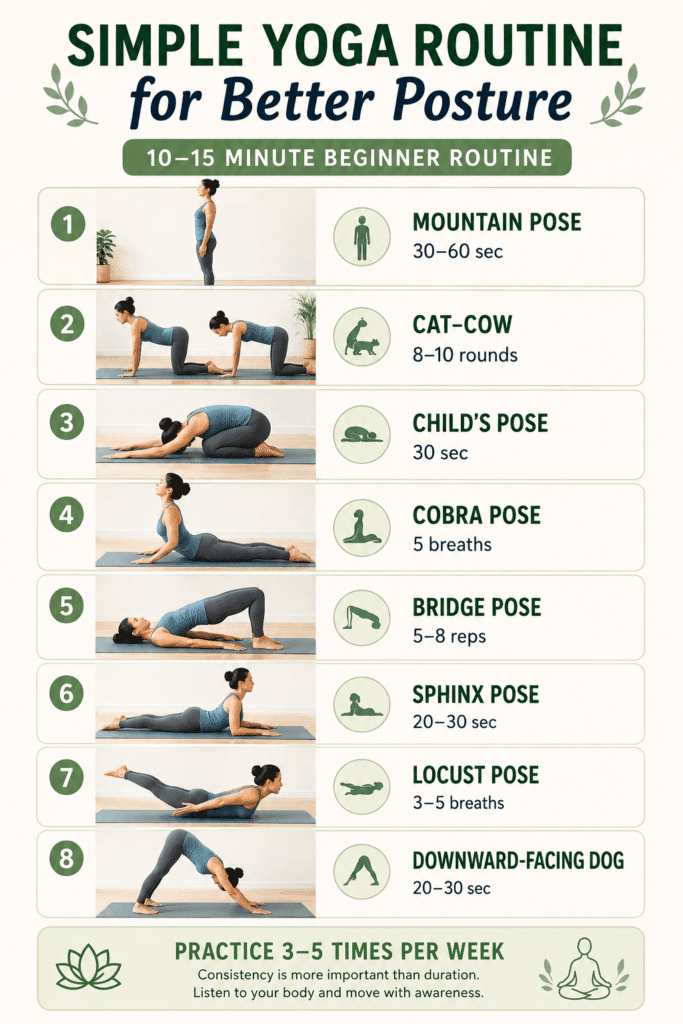
- Mountain Pose — 30–60 seconds
- Cat-Cow — 8–10 rounds
- Child’s Pose — 30 seconds
- Cobra Pose — 5 breaths
- Bridge Pose — 5–8 repetitions
- Sphinx Pose — 20–30 seconds
- Locust Pose — 3–5 breaths
- Downward-Facing Dog — 20–30 seconds
You can practice this routine 3–5 times per week, depending on your comfort and overall activity level.
Consistency is more important than doing a long session occasionally.
How Often Should You Practice Yoga for Posture?
For beginners, regular short sessions can be easier to maintain than occasional long workouts.
You might begin with 10–15 minutes several times per week and gradually increase the duration as you become more comfortable.
However, yoga should not be your only strategy for better posture.
Pay attention to your everyday habits too.
For example:
- Take regular breaks from prolonged sitting.
- Change positions throughout the day.
- Keep your screen at a comfortable height.
- Avoid constantly looking down at your phone.
- Strengthen your core and back gradually.
- Choose a comfortable sitting position rather than forcing yourself rigidly upright.
Remember that there is no single perfect posture that you must maintain all day.
Common Posture Mistakes to Avoid
When practicing yoga for better posture, avoid these common mistakes.
Forcing your shoulders backward
Trying to keep your shoulders pulled back all the time can create unnecessary tension.
Instead, allow your shoulders to rest naturally while keeping your chest comfortably open.
Overarching the lower back
Standing taller does not mean pushing your hips forward or excessively arching your lower back.
Focus on balanced alignment.
Looking up too much
During yoga poses, avoid unnecessarily lifting your chin or compressing your neck.
Keep your head and neck comfortable.
Holding your breath
Breathing should remain steady during your practice.
If you cannot breathe comfortably, reduce the intensity of the pose.
Trying to achieve perfect alignment
Every body is different.
Use alignment as a guide rather than forcing your body into a position that causes pain or discomfort.
Safety Tips for Beginners
Yoga should feel challenging at times, but it should not cause sharp or severe pain.
Keep these tips in mind:
- Start slowly.
- Warm up before more demanding poses.
- Use a yoga mat or another stable surface.
- Modify poses when necessary.
- Stop if you experience sharp pain, dizziness, or unusual symptoms.
- Do not force your flexibility.
- If you have an existing injury or persistent pain, seek professional medical advice before starting a new exercise routine.
Frequently Asked Questions
Is yoga good for bad posture?
Yoga can support healthier posture by improving body awareness, flexibility, strength, and mobility. However, posture problems can have many causes, so yoga should be viewed as one part of an overall approach rather than a guaranteed cure.
Which yoga pose is best for posture?
Mountain Pose is an excellent starting point because it teaches basic standing alignment and body awareness. Other poses, such as Bridge Pose, Cobra Pose, Cat-Cow, and Locust Pose, can complement it by working on mobility and strength.
Can beginners do yoga for posture?
Yes. Beginners can start with simple poses such as Mountain Pose, Cat-Cow, Child’s Pose, and Sphinx Pose. Begin with short sessions and focus on comfortable movement rather than advanced flexibility.
How long does it take to improve posture with yoga?
There is no single timeline because posture is influenced by strength, mobility, daily habits, activity levels, and individual body structure. Consistent practice can help develop better awareness and movement habits over time.
Can yoga fix rounded shoulders?
Yoga may help address some factors associated with rounded shoulders by strengthening supporting muscles and stretching tight areas. However, it cannot guarantee that rounded shoulders will be permanently corrected.
How many minutes of yoga should I do for better posture?
Beginners can start with around 10–15 minutes several times per week. As you become comfortable, you can gradually increase your practice.
Final Thoughts
Practicing yoga for better posture is not about forcing your body to stay perfectly straight. It is about developing strength, mobility, balance, and awareness so you can move and position your body more comfortably.
The eight beginner-friendly poses in this guide provide a simple place to start. Mountain Pose can help you understand standing alignment, while Cat-Cow encourages spinal movement. Poses such as Cobra, Sphinx, Bridge, and Locust strengthen and open different areas of the body.
Start gently, practice consistently, and pay attention to how your body feels.
With regular practice and healthier everyday movement habits, yoga can become a valuable part of your approach to supporting better posture.