
Yoga for beginners at home can be a simple and safe way to start a regular yoga practice. If you’re new to yoga, you don’t need to be flexible or experienced to begin. With a comfortable space, a yoga mat, and a few minutes of practice, you can start at your own pace.
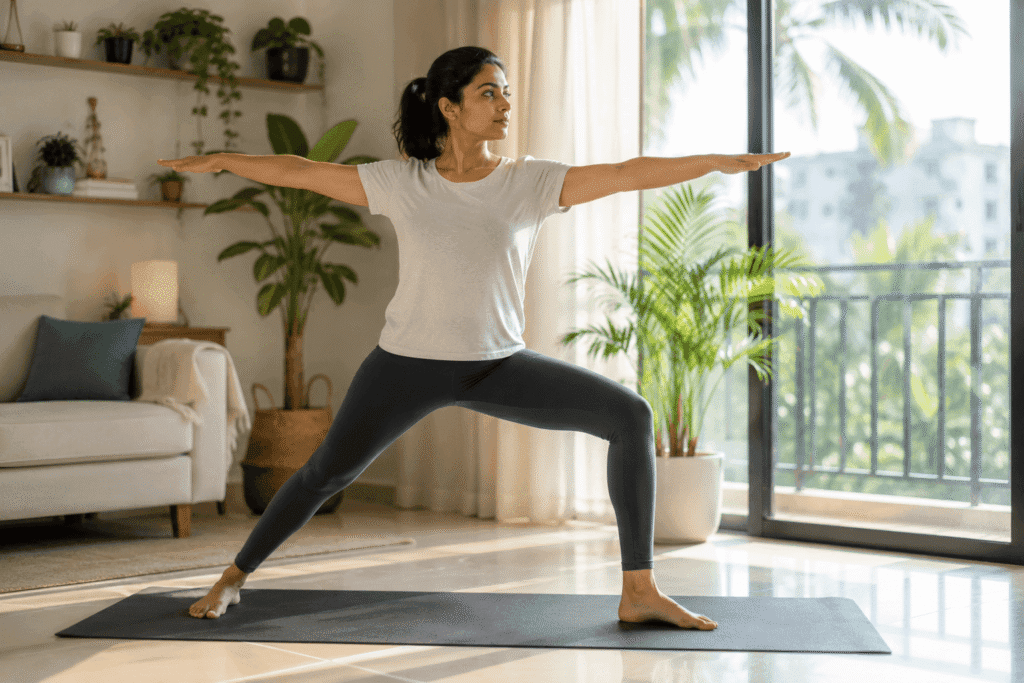
Yoga combines physical postures, breathing techniques, and relaxation or meditation practices. For many people, a regular yoga practice can support flexibility, balance, stress management, sleep, and overall well-being.
If you are completely new to yoga, the most important thing is to start slowly and focus on learning the basics. This beginner-friendly guide explains how to start yoga at home, what you need, which poses to try first, how long to practice, and how to avoid common mistakes.
If you are new to yoga, start with beginner yoga poses and safety tips before trying more challenging practices
Why Start Yoga at Home?
Practicing yoga at home can be a convenient way to introduce movement into your daily routine. You don’t need to travel to a studio or spend a lot of money on equipment.
Some benefits of practicing yoga at home include:
- At home practice in a comfortable and private environment.
- Beginners can begin with short sessions.
- Repeat beginner-friendly poses until you feel comfortable with each movement.
- Over time gradually build a consistent routine.
- Most importantly choose gentle practices that match your current ability.
Yoga may also support general wellness, including stress management, mental and emotional well-being, sleep, balance, and healthy activity habits.
The goal at the beginning isn’t to become flexible quickly. The goal is to develop a safe and enjoyable habit.
You can begin with easy yoga poses for beginners at home and gradually build your confidence and flexibility.
What Do You Need to Start Yoga at Home?
One of the best things about beginner yoga is that you don’t need a large collection of equipment.
You don’t need expensive equipment to start yoga at home. A yoga mat, comfortable clothing, and a little space are enough for most beginners.
For example, beginners can start with simple poses and gradually increase their practice.
1. A Yoga Mat
A yoga mat can provide cushioning and help prevent your hands and feet from slipping during practice.
Choose a mat that feels comfortable and provides enough grip for your practice.
2. Comfortable Clothing
Wear clothing that allows you to move comfortably.
You don’t need expensive yoga clothes. A comfortable T-shirt, leggings, track pants, or other flexible clothing can work well.
3. A Quiet Space
Choose a small area where you can move without bumping into furniture.
You don’t need a large room. Even a clear section of your bedroom or living room can be enough.
4. Water
Keep water nearby, especially if your practice is longer or you are exercising in a warm environment.
5. Optional Yoga Props
As you become more comfortable, you may want to use simple props such as:
- Yoga blocks
- Yoga strap
- Folded blanket
- Cushion
Props aren’t required for your first yoga session, but they can make some poses more comfortable and accessible.
Step 1: Decide Why You Want to Start Yoga
Before beginning, think about your main reason for practicing yoga.
Your goal might be to:
- Improve flexibility
- Build strength
- Reduce everyday stress
- Improve balance
- Support better sleep
- Develop a regular exercise habit
- Spend more time relaxing and focusing on yourself
Having a simple goal can help you stay consistent.
Instead of saying, “I need to become flexible,” try setting a realistic goal such as:
“I will practice beginner yoga for 15 minutes three times this week.”
Small goals are easier to maintain than trying to change everything at once.
Step 2: Choose the Best Time to Practice
There is no single perfect time of day for everyone.
Some beginners enjoy practicing in the morning because it helps them start the day with movement and quiet time. Others prefer evening yoga because it gives them an opportunity to slow down after a busy day.
Choose a time that you can realistically maintain.
If you are interested in comparing morning and evening practice, read our guide:
The best time is often the time that fits naturally into your schedule.
Step 3: Start With a Short Yoga Session
You don’t need to practice for an hour when you’re just starting.
A 10- to 20-minute beginner session can be a reasonable starting point for many healthy adults.
For example:
Week 1: 10–15 minutes
Week 2: 15–20 minutes
Week 3: 20–25 minutes
Week 4: 20–30 minutes
This isn’t a strict program. If 10 minutes feels appropriate for you, stay there until you feel ready to increase your practice.
Consistency is more important than making your first session very long.
Step 4: Begin With Simple Yoga Poses
When you’re learning how to start yoga at home, choose simple poses that allow you to focus on alignment, breathing, and body awareness.
Here are several beginner-friendly poses to learn.
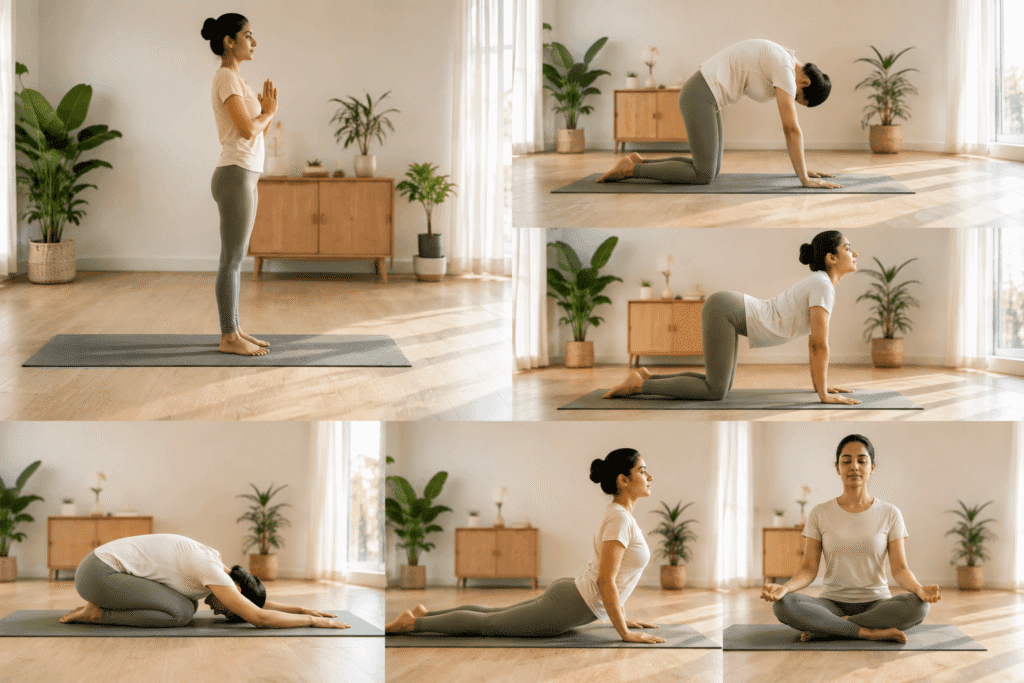
Mountain Pose
Mountain Pose is a simple standing posture that can help you learn basic alignment and body awareness.
How to practice:
- Stand with your feet comfortably positioned.
- Keep your spine tall.
- Relax your shoulders.
- Let your arms rest naturally by your sides.
- Look forward.
- Take several slow, comfortable breaths.
Don’t worry about making the pose perfect. Focus on standing comfortably and noticing your posture.
Child’s Pose
Child’s Pose is a gentle resting position commonly used during yoga practice.
How to practice:
- Begin on your hands and knees.
- Slowly move your hips toward your heels.
- Allow your upper body to move forward comfortably.
- Rest your hands where they feel comfortable.
- Breathe slowly.
If your knees, hips, ankles, or back feel uncomfortable, modify the position or choose another resting posture.
Cat-Cow Stretch
Cat-Cow can introduce gentle movement through the spine.
How to practice:
- Begin on your hands and knees.
- Place your hands under or slightly forward of your shoulders.
- Place your knees comfortably underneath your hips.
- Slowly move your spine through a comfortable range.
- Coordinate your movement with slow breathing.
- Repeat several times without forcing the movement.
Move slowly rather than trying to create a large range of motion.
Downward-Facing Dog
Downward-Facing Dog is a familiar yoga posture, but it may feel challenging for beginners.
How to practice:
- Begin on your hands and knees.
- Place your hands firmly on the mat.
- Slowly lift your hips upward.
- Keep your knees slightly bent if needed.
- Allow your head and neck to remain relaxed.
- Take slow breaths.
- Return to your hands and knees when you need a break.
You don’t need to straighten your legs completely.
Cobra Pose
Cobra Pose can be introduced gently as part of a beginner sequence.
How to practice:
- Lie on your stomach.
- Place your hands near your shoulders.
- Keep your elbows close to your body.
- Gently lift your chest using a comfortable range of motion.
- Avoid forcing your lower back.
- Lower yourself slowly.
Keep the movement gentle and stop if you experience pain.
Seated Forward Bend
This seated posture can introduce gentle stretching to the back of the body.
How to practice:
- Sit comfortably with your legs extended or slightly bent.
- Keep your spine as comfortable and upright as possible.
- Slowly hinge forward from your hips.
- Reach toward your legs without forcing yourself.
- Stop at a comfortable point.
- Breathe slowly.
You do not need to touch your toes to perform this pose correctly.
Corpse Pose
Corpse Pose, also called Savasana, is commonly used at the end of a yoga session.
How to practice:
- Lie comfortably on your back.
- Allow your arms to rest by your sides.
- Let your legs relax.
- Close your eyes if comfortable.
- Take slow, natural breaths.
- Stay still for a few minutes.
This gives you an opportunity to relax after your physical practice.
Step 5: Learn to Breathe Comfortably
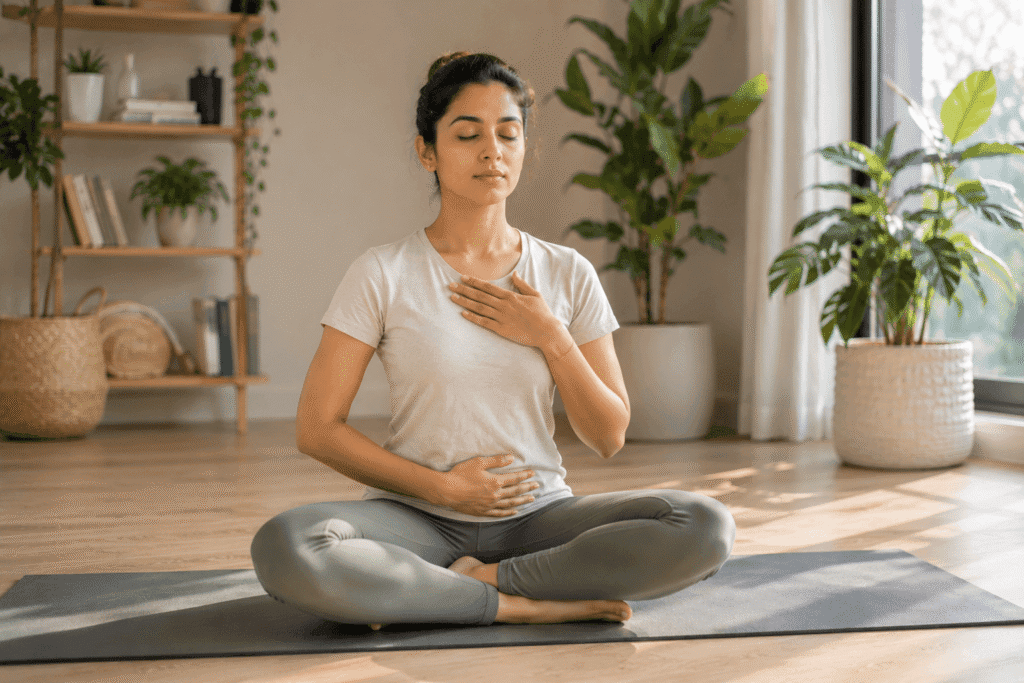
Breathing is an important part of yoga.
As a beginner, don’t worry about complicated breathing techniques. Start by paying attention to your natural breath.
Try this simple approach:
- Breathe in slowly through your nose if comfortable.
- Breathe out gently.
- Avoid holding your breath during ordinary poses.
- Keep your breathing relaxed.
- Move slowly rather than rushing.
You don’t need to force deep breathing.
More advanced breathing practices should be learned carefully and, when appropriate, with guidance from a qualified teacher.
Step 6: Create a Simple Beginner Yoga Routine
Once you’ve learned a few basic poses, you can combine them into a short home routine.
15-Minute Beginner Yoga Routine
1. Comfortable seated breathing — 2 minutes
Sit comfortably and take slow, natural breaths.
2. Mountain Pose — 1 minute
Stand tall and focus on your posture.
3. Cat-Cow — 2 minutes
Move slowly with comfortable breathing.
4. Child’s Pose — 2 minutes
Relax and breathe comfortably.
5. Downward-Facing Dog — 2 minutes
Hold only for as long as it feels comfortable.
6. Cobra Pose — 1 minute
Practice gentle movements without forcing your back.
7. Seated Forward Bend — 2 minutes
Move only within a comfortable range.
8. Corpse Pose — 3 minutes
Relax and allow your breathing to return to normal.
You can shorten or modify this routine according to your ability.
How Often Should Beginners Practice Yoga?
You don’t have to practice yoga every day to begin building a routine.
A beginner might start with two or three short sessions per week and gradually increase frequency if the practice feels comfortable.
For example:
Monday: 15-minute yoga session
Wednesday: 15-minute yoga session
Saturday: 20-minute yoga session
As you become more comfortable, you can decide whether you want to practice more frequently.
The most important thing is to listen to your body rather than feeling pressured to practice a certain number of days.
If you want to learn more about daily practice, read:
You do not need to practice for long hours every day. Learn how often beginners should practice yoga and create a routine that fits your body and schedule.
Common Mistakes Beginners Should Avoid
Starting slowly can help you develop better habits.
Trying Advanced Poses Too Soon
Headstands, shoulder stands, difficult arm balances, and other advanced practices aren’t necessary for beginners.
Focus on learning basic movements first.
Comparing Yourself With Other People
Everyone has a different body, flexibility level, strength level, and experience.
Your yoga practice doesn’t need to look like someone Elsie’s.
Forcing a Stretch
A stronger stretch isn’t automatically a better stretch.
Avoid pushing your body aggressively into a position. Work within a comfortable range and gradually improve over time.
Holding Your Breath
Try to keep your breathing relaxed during your practice.
If you notice that you’re holding your breath because a pose feels difficult, come out of the pose or modify it.
Practicing Through Pain
Yoga should not be a competition.
If a movement causes pain, stop and reassess the position. You may need to modify the pose or choose a different movement.
Making Your First Session Too Long
A long first session can leave you tired or discouraged.
Start small and increase gradually.
Avoiding common yoga mistakes beginners should avoid can help you build a safer and more sustainable practice.
How to Practice Yoga Safely at Home
Yoga is generally considered safe for healthy people when practiced appropriately, but injuries can still happen. Sprains and strains are among the more common yoga-related injuries.
To make your home practice safer:
- Start with beginner-level poses.
- Warm up with gentle movements.
- Don’t force your flexibility.
- Keep your movements controlled.
- Use a stable, non-slip surface.
- Keep enough space around your mat.
- Rest whenever you need to.
- Stop if you feel pain or become unwell.
- Learn proper technique from a qualified instructor when possible.
Beginners are generally advised to avoid advanced practices such as headstands, shoulder stands, lotus position, and forceful breathing until they have appropriate experience and guidance.
If you are pregnant, have an injury, have a medical condition, or have concerns about whether yoga is suitable for you, speak with an appropriate healthcare professional and consider working with a qualified yoga instructor. Some poses and practices may need to be modified or avoided.
What Should You Do After Your Yoga Practice?
After finishing your yoga session, take a few minutes to relax.
You can:
- Sit or lie down quietly.
- Take comfortable breaths.
- Drink some water.
- Notice how your body feels.
- Avoid immediately rushing into another activity if you need a short rest.
You don’t need to do anything complicated after a beginner session.
If you’re interested in nutrition around yoga, read:
How to Stay Consistent With Yoga at Home
Starting is often easier than staying consistent.
Try these simple strategies:
Keep Your Routine Short
A 15-minute routine can be easier to maintain than a one-hour routine that you rarely complete.
Practice at the Same Time
If possible, connect yoga with an existing part of your day.
For example:
Wake up → drink water → practice yoga
or:
Finish work → change clothes → practice gentle yoga
Keep Your Yoga Mat Visible
If your mat is stored somewhere difficult to reach, you may be less likely to use it.
Keeping your practice area ready can make starting easier.
Focus on Consistency, Not Perfection
Missing one session doesn’t mean you’ve failed.
Simply return to your routine when you’re ready.
A Simple 4-Week Beginner Yoga Plan
Here’s an easy way to gradually build your home practice.
Week 1: Learn the Basics
Practice for 10–15 minutes, two or three times during the week.
Focus on:
- Breathing
- Mountain Pose
- Cat-Cow
- Child’s Pose
- Gentle relaxation
Week 2: Add More Movement
Practice for 15–20 minutes, two or three times during the week.
Add:
- Downward-Facing Dog
- Gentle Cobra Pose
- Seated Forward Bend
Week 3: Build Your Routine
Practice for around 20 minutes, three times during the week.
Combine several poses into a simple sequence.
Week 4: Find Your Comfortable Rhythm
Practice for 20–30 minutes as appropriate for you.
You can begin deciding which poses, breathing exercises, and relaxation techniques you enjoy most.
Remember, this is a flexible example rather than a requirement. Your routine should match your current ability and comfort.
Final Thoughts
Learning how to start yoga at home doesn’t have to be complicated.
Most importantly, make yoga a practice that supports your well-being rather than another source of pressure. Start where you are, progress gradually, and listen to your body.
You don’t need perfect flexibility, expensive equipment, or long workouts. Start with a small, comfortable space and a few simple poses. Pay attention to your breathing, move gently, and give yourself time to learn.
A short and consistent practice can be more useful than pushing yourself through difficult poses before you’re ready.
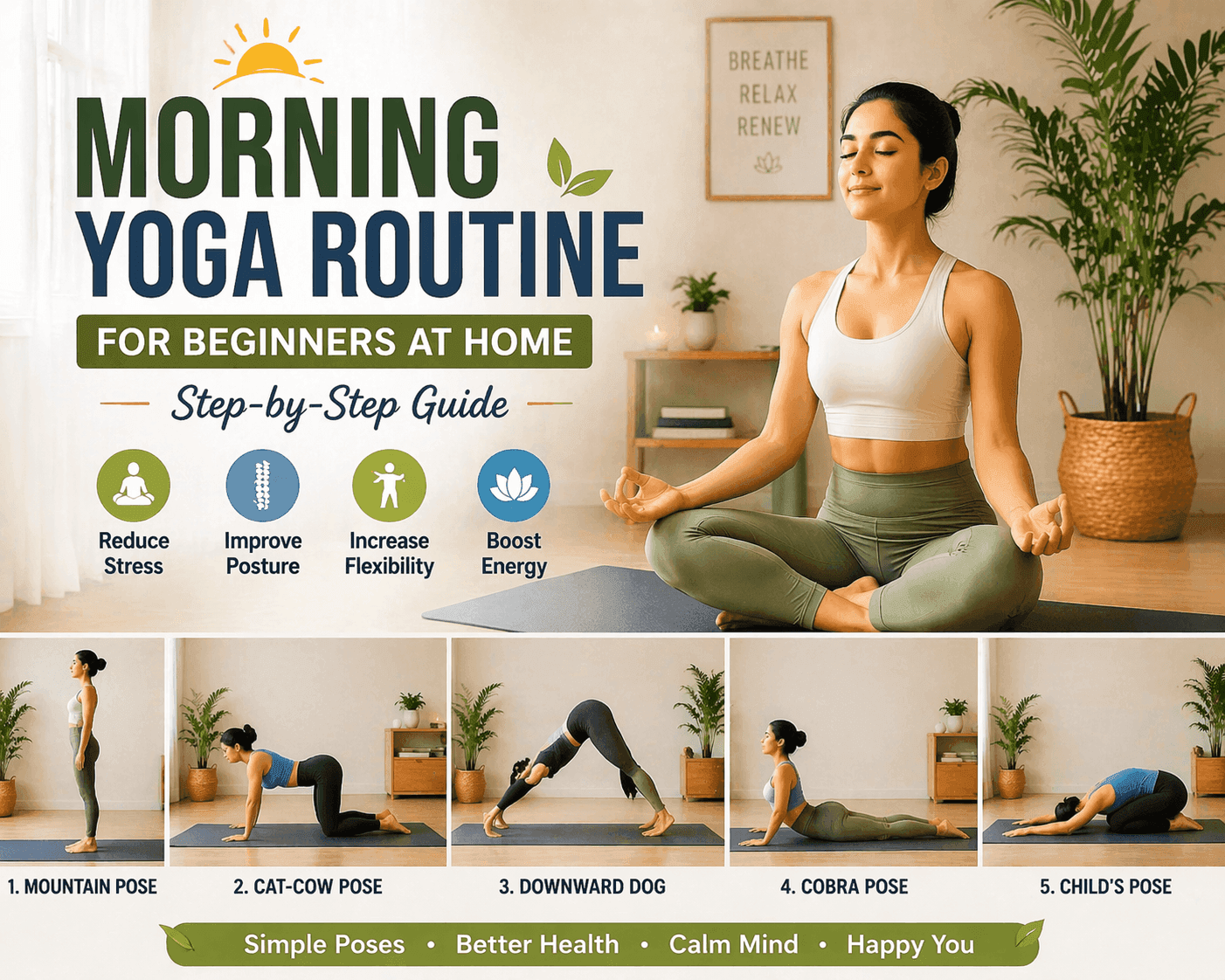
If you prefer practicing in the morning, try this simple morning yoga routine for beginners to start your day gently.
Frequently Asked Questions
1.Can I start yoga at home without a teacher?
Yes, many beginners start learning basic yoga at home. However, proper instruction can be helpful for learning alignment and reducing the risk of practicing movements incorrectly. If you’re unsure about a pose, learning from a qualified instructor can be beneficial.
2.How long should a beginner practice yoga?
You can begin with a short session, such as 10–20 minutes, and gradually increase the duration as you become more comfortable. There is no need to start with a long session.
3.Can I do yoga if I’m not flexible?
Yes. You do not need to be flexible to begin yoga. Flexibility is not a requirement for starting a beginner practice.
Choose simple movements and work within a comfortable range rather than trying to force your body into a pose.
4.Do I need expensive yoga equipment?
No. A yoga mat and comfortable clothing are enough for many beginner practices. Blocks, straps, blankets, and other props can be added later if you find them useful.
5.Is 15 minutes of yoga enough for a beginner?
A 15-minute session can be a practical starting point, especially if it helps you establish a consistent routine. As you become more comfortable, you can gradually adjust the duration.
6.Can I practice yoga every day?
Some people choose to practice yoga every day, but daily practice isn’t necessary for everyone. The appropriate frequency depends on the type and intensity of practice, your experience, and your individual circumstances.
If you choose to practice frequently, include gentle or restorative sessions and allow your body to recover when needed.
7.What should I do if a yoga pose hurts?
Stop the movement and don’t force yourself through pain. Try coming out of the pose, resting, or modifying the movement. If you have ongoing or concerning symptoms, seek appropriate medical advice.
Your yoga journey can begin with just a few minutes today.