
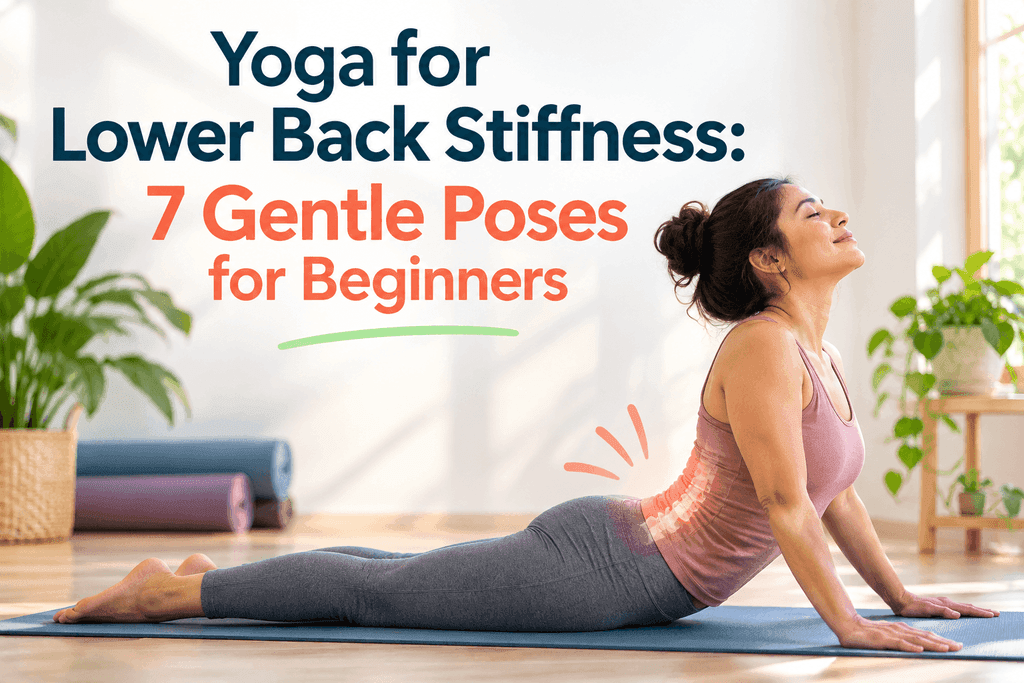
Yoga for lower back stiffness may help some beginners explore gentle movement, improve flexibility, and feel more comfortable during everyday activities. The right movements depend on the cause of the stiffness, so start slowly and avoid any pose that increases pain.
If you spend long hours sitting or are beginning your yoga journey, simple movements may help you move more comfortably. However, lower back stiffness can have different causes, and yoga is not suitable for every condition.
In this guide, you will learn seven gentle yoga poses, how to practice them, and important safety tips for beginners.
You may also find our guide to Yoga for Better Posture helpful.
Can Yoga Help With Lower Back Stiffness?
Gentle yoga combines movement, breathing, and relaxation. For some people, it may help improve mobility, flexibility, and confidence with everyday movement.
Yoga should not cause sharp or increasing pain. Start slowly, avoid forcing stretches, and seek medical advice if your symptoms persist or worsen.
7 Gentle Yoga Poses for Lower Back Stiffness
1. Cat-Cow Pose (Marjaryasana-Bitilasana)
Cat-Cow is a gentle movement that encourages comfortable motion through the spine.
How to practise:
- Begin on your hands and knees, with your hands under your shoulders and knees under your hips.
- Breathe in and gently lift your chest, allowing your back to move into a comfortable arch.
- Breathe out and gently round your back without forcing your neck.
- Move slowly between the two positions for 5–8 comfortable rounds.
Tip: Keep the movement small if your back feels sensitive.
2. Child’s Pose (Balasana)
Child’s Pose is a resting position that some beginners find relaxing.
How to practise:
- Kneel on a yoga mat.
- Slowly move your hips towards your heels, only as far as comfortable.
- Rest your hands forward or beside your body.
- Breathe gently for 15–30 seconds if the position feels comfortable.
Tip: Place a cushion under your hips or chest for support. Skip this pose if kneeling or bending increases your symptoms.
3. Pelvic Tilts
Pelvic tilts involve a small, controlled movement of the pelvis while lying down.
How to practise:
- Lie on your back with your knees bent and feet flat on the floor.
- Keep your shoulders relaxed.
- Gently tighten your abdominal muscles and tilt your pelvis so your lower back moves slightly towards the floor.
- Relax and return to your natural position.
- Repeat 5–10 times without holding your breath.
Tip: Keep the movement gentle rather than pressing forcefully into the floor.
4. Knee-to-Chest Stretch
This gentle stretch may feel comfortable for some people, but it is not suitable for everyone.
How to practise:
- Lie on your back with both knees bent.
- Slowly bring one knee towards your chest, holding behind your thigh if needed.
- Keep the other foot on the floor if that feels more comfortable.
- Hold for 10–15 seconds while breathing normally.
- Release gently and switch sides.
Tip: Stop if you experience pain, tingling, or symptoms travelling down your leg.
5. Supported Bridge Pose (Setu Bandha Sarvangasana)
A gentle bridge variation engages the muscles around the hips and trunk.
How to practise:
- Lie on your back with your knees bent and feet hip-width apart.
- Keep your arms beside your body.
- Gently lift your hips a small distance, only if comfortable.
- Breathe normally for a few seconds.
- Lower your hips slowly. Repeat 3–5 times.
Tip: Avoid lifting too high or arching your back forcefully. Skip the pose if it increases your pain.
6. Supine Figure-Four Stretch
This pose gently stretches the outer hip, which may feel tight after prolonged sitting.
How to practise:
- Lie on your back with both knees bent.
- Place one ankle across the opposite thigh, above the knee.
- Stay in this position if you already feel a gentle stretch.
- If comfortable, bring the supporting thigh slightly towards you.
- Hold for 10–20 seconds, then change sides.
Tip: Do not push your knee down or pull your leg forcefully. Stop if you feel pain or numbness.
7. Comfortable Supine Rest
Relaxation is a useful way to finish a gentle yoga session.
How to practise:
- Lie on your back with your knees bent and feet resting on the mat.
- Place a pillow beneath your knees if that feels better.
- Relax your shoulders and jaw.
- Breathe naturally for 1–2 minutes.
- Roll onto your side before slowly sitting up.
Tip: Choose a position that feels comfortable for your back. You do not need to force yourself to lie flat.
A Simple 8–10 Minute Beginner Routine
If the movements feel comfortable, try this short routine:
- Cat-Cow: 1–2 minutes
- Pelvic tilts: 1 minute
- Child’s Pose or supported rest: 1 minute
- Knee-to-chest stretch: 1 minute
- Supported Bridge Pose: 1 minute
- Supine Figure-Four Stretch: 2 minutes
- Comfortable Supine Rest: 1–2 minutes
Move slowly, breathe normally, and skip any movement that causes discomfort. This is an optional routine, not a treatment plan. There is no need to complete every pose.
Safety Tips Before Practising Yoga
- Start with small, comfortable movements.
- Avoid bouncing, forceful twisting, or deep forward bends if they worsen your symptoms.
- Stop if pain becomes sharp, increases, or travels down your leg.
- If you have a recent injury, known spinal condition, osteoporosis, or unexplained persistent pain, ask a qualified healthcare professional which movements are appropriate.
- Seek urgent medical attention for back pain accompanied by new difficulty controlling your bladder or bowels, numbness around the groin or saddle area, or significant or progressive leg weakness.
Consult a healthcare professional if stiffness persists, keeps returning, affects daily activities, or is accompanied by fever, unexplained weight loss, or other concerning symptoms.
Read the NHS guidance on back pain for more information about symptoms and when to seek medical advice.
Frequently Asked Questions
Is yoga good for lower back stiffness?
Gentle yoga may help some people improve flexibility, movement, and relaxation. Its suitability depends on the cause of the stiffness and the individual’s symptoms.
How long should beginners practise?
Start with a few comfortable minutes rather than a long session. Increase gradually only if the movements feel appropriate and do not worsen symptoms.
Should I practise yoga when my back hurts?
Do not force a yoga session through pain. If symptoms are new, severe, worsening, or unexplained, seek medical advice before continuing.
Can I practise these poses every day?
Some people tolerate gentle movement daily, but there is no need to practise every pose every day. Adjust according to comfort and professional guidance where needed.
Final Thoughts
Gentle yoga can be one option for exploring comfortable movement when experiencing mild lower back stiffness. Begin slowly, choose supported positions, and avoid pushing beyond your limits.
Your goal is not to achieve a perfect pose. It is to move comfortably and listen to your body. If your symptoms persist or worsen, consult a qualified healthcare professional rather than relying on yoga alone.
If you are new to yoga, read our guide on How to Start Yoga at Home for Beginners.